Sunday, 3 April 2016

J Walter Kennedy

        The 2nd Commissioner of the NBA, J. Walter Kennedy, who served from 1963 to 1965.

  J. Walter Kennedy was born in Stamford, Connecticut in 1912. Kennedy was diagnosed with Polio at an early age and was therefore unable to compete in sports, but that did not dampen his love for them. After graduating from Notre Dame, he began his career as a basketball coach, culminating in a very good run as the coach of St Basil's Prep School in Stamford. In the 1940s he returned to Notre Dame as their athletic director until moving on to become the Public Relations director of the BAA just months before it merged with the NBL, forming the NBA. In 1963, NBA owners voted him to be the league's next President after the retirement of Maurice Podoloff.

   Early into his term, Kennedy established himself as an iron-handed executive who ran the league strongly. He was known to exert his authority by levying out large fines and punishments against players and coaches whose actions he deemed detrimental to the NBA.

 Kennedy inherited the NBA at a bad time, seeing decreased attendance, viewership and heavy competition from the ABA. By the time he retired, the league had added 9 teams, tripled attendance and saw a 200% increase in viewership.

   Despite ruling the NBA with an iron-fist, Kennedy was known as a very kind and approachable man. He was involved in many social issues such as the Special Olympics and the Boys and Girls Clubs of America. He is memorialized with the J. Walter Kennedy Citizenship Award, given annually to an NBA player or coach who shows outstanding work in their community.

Maurice Podoloff Trophy

                   The Maurice Podoloff Trophy, given out annually to the MVP of the NBA

Maurice Podoloff

                   The 1st Commissioner of the NBA, Maurice Podoloff served from 1946 to 1963.

 Maurice Podoloff was a Russian-American lawyer who served as the 1st commissioner of the NBA. He was originally the commissioner of the Basketball Association of America (BAA) until it merged with the National Basketball League to form what we now know as the National Basketball Association.

   Podoloff was born somewhere in Russia sometime in August 1890, though the specifics are not known for sure. On this Podoloff said " I was born on either Aug. 18 or Aug. 31, and it was somewhere in Russia, possibly near Odessa." A a young man the Podoloff family migrated to Connecticut. In 1915, he graduated from Yale with a law degree.

 Podoloff was a well established and highly respected attorney, who while simultaneously serving as President of the American Hockey League, was appointed President of the BAA. He was the person who first installed the collegiate draft in the BAA and oversaw the merger with the NBL. While serving as NBA Commissioner, he introduced the 24 second shot clock and greatly introduced national interest in basketball by landing the sport's first TV contract.

 Podoloff stepped down in 1963 after a 19 year run that saw incredible growth in popularity in basketball. He is highly regarded by basketball historians as one of the key people in the rise of the NBA and is memorialized by the Maurice Podoloff Trophy, given to the Leagues Most Valuable Player.

Thursday, 31 March 2016

The Commissioner

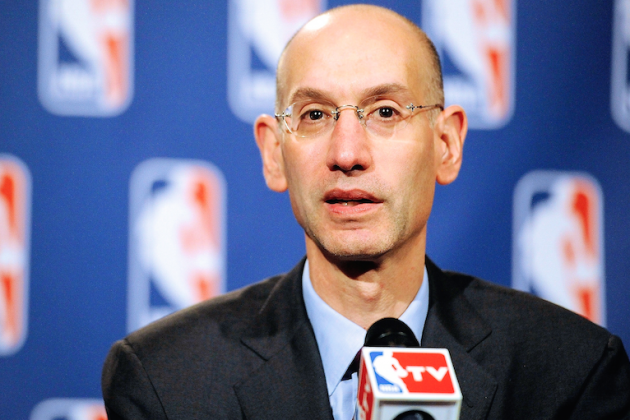
    The current Commissioner of the NBA, Adam Silver has held the position since February 1st 2014.


   The most powerful person in the NBA and perhaps the entire basketball world is the commissioner of the NBA. He is more or less the CEO of the NBA and controls both the business aspect of the league and the game itself. It is his job to run the league, but also punish teams for rule violations, help create new rules and create a Collective Bargaining Agreement with the NBA Player's Association, the union for NBA Players. Their have been 5 commissioners since the creation of the league in 1946.

The list of people who have held the position is as follows;

Maurice Podoloff (1946-1963)
J. Walter Kennedy (1963-1975)
Larry O'Brien (1975-1984)
David Stern (1984-2014)
Adam Silver (2014-Present)

The Ball

                   The first game was played with a leather soccer ball, similar to this one


In the late 1890's, James Naismith contacted AG Spalding and commissioned him to make a ball for his new game. The ball he created was an inflatable rubber inside coated with layers of leather,and it had a set of laces of the outside to make it easier to hold.

In the late 1950's, the NBA changed the colour of their official basketball from brown to orange, to make it easier to see for observers.


  In the 1960's, the American Basketball Association introduced the famous red white and blue ball to league play. This colourful ball is one of the most popular basketballs ever and is still often used by amateur players today.


The current official NBA Game Ball, created by Spalding. This ball is similar to early models with the same kind of inflatable bladder on the inside, but the outside is coated in a composition material that grips better and is tougher, making it ideal for extended use.

The National Basketball League: The First Professional League

The original NBL was formed in 1898 in Philadelphia, Pennsylvania as a way to protect local players from exploitation and to try to promote a safer game. The leagues teams were largely based out of Pennsylvania, New Jersey and New York.


The first NBL game was played in 1898 in Philadelphia between the Trenton Nationals and the Hancock Athletic Association at the Textile Hall in Philadelphia in front of 900 fans. The Nationals won this game 21-19.The 1898-99 season saw six teams in the league. Three were in Philadelphia: Clover Wheelmen, Germantown Nationals, and Hancock Athletic Association; and three were in New Jersey: Millville Glass Blowers, Camden Electrics, and Trenton Nationals. Two of the Philadelphia teams folded prior to New Year's Eve 1898, but the other four completed the season, with the Trenton Nationals winning the first championship with an 18-2-1 record.

The National Basketball League began the 1900-1901 season with an expanded schedule of 32 games, and seven teams. Of the seven teams, six had participated in league play before, the only new entry, from Burlington NJ, failed to complete the season. The seven teams were the New York Wanderers, Trenton Nationals, Millville Glass Blowers, Bristol Pile Drivers, Camden Skeeters, Pennsylvania Bicycle Club, and Burlington. The 1902-1903 was the season was again a split season. There were eight first half teams—Camden Electrics, New York Wanderers, Bristol Pile Drivers, Philadelphia Phillies, Trenton Potters, Conshohocken, and Burlington Shoe Pegs. The second half of the season saw only six teams—Camden Electrics, Burlington Shoe Pegs, Wilmington Peaches, Trenton Potters, New York Wanderers, and Conshohocken. Two teams dropped out before the season finished. The Burlington team was doing so poorly that its owner-coach, Frank Reber, fired his entire team, purchased the Bristol franchise and used Bristol's players to represent Burlington.

In 1903, only 5 teams elected to return to the NBL for the upcoming season, New York, Burlington, and Wilmington failed to return. The league began the season with only five teams, Camden Electrics, Trenton Potters, Conshohocken, Millville Glass Blowers, and St. Bridget's Biddies. Trenton dropped out on December 26, 1903, and Camden left on December 31. The disbanded on National Basketball League January 4, 1904

The Rise of College Baketball

                            The 1899 Kansas Men's Team, one of the earliest College Basketball teams

The rise of the game of basketball in the late 1800's and early 1900's was largely due to YMCA's in different areas of the United States and Canada's willingness to sanction games and have them played on their courts. However, within a decade of the YMCA beginning to promote the sport, they withdrew their willingness to have games played their because they often drew large and rowdy crowds that the YMCA believed was not a part of their ultimate goal. After this the game was still played by other amatuer associations, but it struggled to find the same compounded popularity it found at the YMCA. This led to a massive surge in popularity of college basketball, games played between 2 teams of student representing their respective university.

 It is believed that the first college to play a game against an outside team was Vanderbilt University in Nashville, Tennessee in 1893. This game was played against the local Nashville YMCA team (while the YMCA still fielded teams)

The first 5-game between 2 schools was played in 1895 between Hamline University and Minnesota A&M, which was won by A&M 9-3. The first 5-on-5 game is believed to have been played between the University of Chicago and the University of Iowa in 1896. Chicago won 15-12, coached by Amos Stagg, who learned the game from James Naismith at the Springfield YMCA. By 1900, the game of basketball had spread to many school all throughout the United States.

Due to the concerning frequency of injuries to college football players, in 1905 President Theodore Roosevelt called for the creation of a governing body for all college sports. This led to the creation of the Intercollegiate Athletics Association of the United States (IAAUS). In 1910, the IAAUS was renamed the National Collegiate Athletic Association (NCAA), which it is still known as today.

The first tournament for NCAA teams was the National Invitational Tournament in 1938, but it was not sanctioned by the NCAA. A year later the NCAA started it's on tournament, the NCAA Men's Basketball Tournament (popularly known today as March Madness) which quickly overtook the NIT in popularity due to accusations of game rigging and point shaving in the NIT.